


There’s something quietly extraordinary about watching a Tamil film in Melbourne, surrounded by people who’ve never set foot in India — and seeing them lean forward, completely absorbed. That’s the magic the Indian Film Festival of Melbourne (IFFM) has been conjuring since 2010. And it shows no signs of stopping.
What started as a bold cultural experiment has grown into Australia’s largest annual celebration of Indian cinema outside of India — one that now spans languages, generations, and geographies. Here’s the story of how it happened, moment by remarkable moment.
Where It All Began
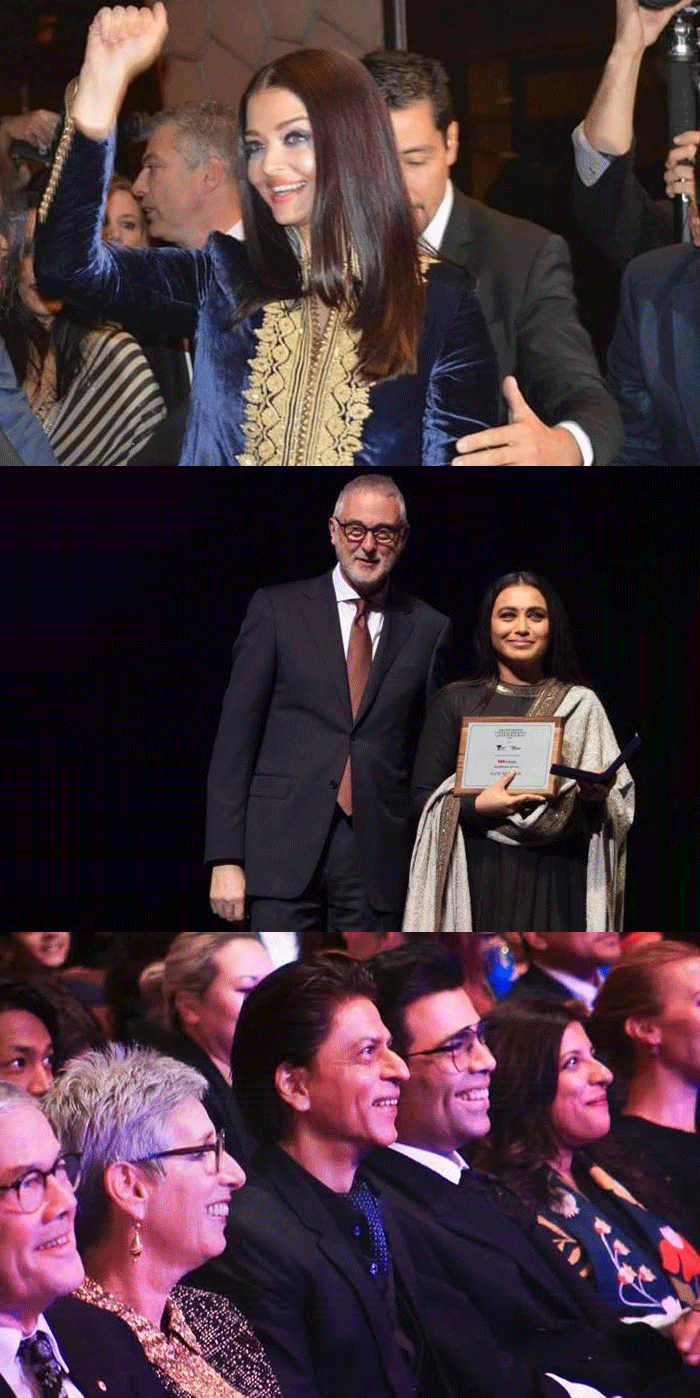
It all started in March 2010 when Mind Blowing Films organised the Indian Film Festival: Bollywood and Beyond. Renowned film actress Rani Mukherjee opened the festival and for the first time, Melbourne witnessed the glitz and glamour of Bollywood. The festival was also attended by established filmmakers Rajkumar Hirani, Imtiaz Ali, and Sohail Khan.
The first edition featured a sweeping showcase of Rani Mukerji’s work — Bunty Aur Babli, Black, Kabhi Alvida Naa Kehna — alongside beloved hits like 3 Idiots, Dev.D, Ghajini, Kaminey, and Wake Up Sid. For the Indian diaspora in Melbourne, it wasn’t just a film screening. It was a homecoming.
The Record That Made History
If there’s one moment that signalled IFFM was here to stay, it’s this one. In 2011, the festival set a new Guinness World Record for the ‘Largest Bollywood Dance’ with 1,500 participants. Imagine 1,500 people moving to the same beat, on Australian soil, celebrating Indian culture. That’s not a festival — that’s a movement.
The 2011 edition also brought notable attendees including actors Vidya Balan, Malaika Arora, Ali Zafar, Juhi Chawla, and directors Kabir Khan and Onir.
2013: From Silent Cinema to Sholay on Five Screens
By 2013, IFFM had grown into something genuinely ambitious. The festival ran for 20 days on 5 screens in Melbourne and opened with India’s first silent film Raja Harishchandra, accompanied by a live band playing the background score, alongside the colourised Mughal-E-Azam. From the birth of Indian cinema to its most iconic epic, all in one opening weekend — that’s a programming statement.
That same year, the International Screen Icon Award went to Amitabh Bachchan, who attended in person. Big B, in Melbourne. The room must have been electric.
The Awards Era Begins: Bold Choices, Bolder Cinema
IFFM introduced its formal awards in 2014, and from the very first edition, the choices told a story about what this festival actually valued.
In 2015, Irrfan Khan won Best Actor for Piku, Bhumi Pednekar won Best Actress for Dum Lagake Haisha, and the Best Indie Film award went to Kaaka Muttai (Crows Eggs) — a Tamil film about two slum children dreaming of eating pizza. A Tamil indie sharing space with mainstream Bollywood at an international awards night. That’s what IFFM stood for.
The 2016 festival opened with Parched and closed with Angry Indian Goddesses, with panel discussions on women in cinema and a masterclass by Richa Chadha on Bollywood and body positivity. It wasn’t just screening films — it was starting conversations.
2019: Shah Rukh Khan Walks Into Melbourne
IFFM 2019 was organised at the Palais Theatre and guests included Shah Rukh Khan, Karan Johar, Zoya Akhtar, Tabu, Sriram Raghavan, and Malaika Arora. The festival celebrated its spectacular tenth year with the King of Bollywood — the biggest names in the industry, over 20 events and films from every corner of India. SRK also received the IFFM Excellence in Cinema Award that year — fitting, for a milestone edition.
Surviving a Pandemic, Then Coming Back Stronger
When the world went into lockdown, IFFM didn’t disappear. The 2020 festival was delayed from its usual time in August to October due to the pandemic and included approximately 50 films in 17 languages.
By 2021, the resilience was remarkable. The 2021 IFFM had 127 films in 27 languages, including films by 34 film directors. It honoured Soorarai Pottru as Best Film, gave the Diversity in Cinema Award to Pankaj Tripathi, and recognised The Great Indian Kitchen with the Equality in Cinema Award — a Malayalam feminist film that had sparked nationwide conversation.
2022: A Record 120+ Films and Cricket Royalty
The 2022 IFFM saw a record number of films — over 120 films in 29 languages screened in cinemas and streaming Australia-wide. Cricket legend Kapil Dev and actor Abhishek Bachchan hoisted the Indian flag at Federation Square for India’s 75th Independence Day.
The best film that year? 83 by Kabir Khan, with Ranveer Singh winning Best Actor — about Kapil Dev’s World Cup victory. Having Kapil Dev himself in the audience while the film about his greatest triumph won top honours? That’s cinema eating itself in the best possible way.
2025: Aamir Khan, Archival Queer Cinema, and a New High
The 16th edition of IFFM, held from August 14 to 24, 2025, featured over 75 films spanning 31 languages. Aamir Khan attended as chief guest, headlining an open-air retrospective of his films at Federation Square and a special screening of his production Sitaare Zameen Par.
The programming reached new depth. A Pride Night dedicated to LGBTQ+ narratives screened the restored 1971 film Badnaam Basti — India’s earliest known queer-themed production — alongside contemporary titles. History and the present, in the same programme, in Melbourne.
The Best Film award went to Neeraj Ghaywan’s Homebound — a filmmaker known for his sensitive, marginalised storytelling, winning the top honour at Australia’s biggest Indian film festival.
What Makes the Love Story Last
IFFM exists to bridge the gap between the Indian film industry and the international stage, fostering meaningful dialogue between cultures through the universal language of cinema. The vision is to showcase the full spectrum of Indian cinema — from Bollywood’s grand narratives to the quiet power of regional and independent films — in a way that is inclusive, authentic, and accessible.
That’s not marketing copy. Fifteen years of programming backs it up.
For Melbourne’s Indian diaspora, IFFM is a mirror. For Australian audiences discovering Indian cinema, it’s a door. And for filmmakers from Kerala, Punjab, Tamil Nadu, and everywhere in between — it’s a stage that says: your story matters here too.
The love affair isn’t slowing down. IFFM 2026 is already on the horizon. And if history is anything to go by, it’ll be bigger, bolder, and more beautifully diverse than ever.
Explore the full programme and stay updated at iffm.com.au