


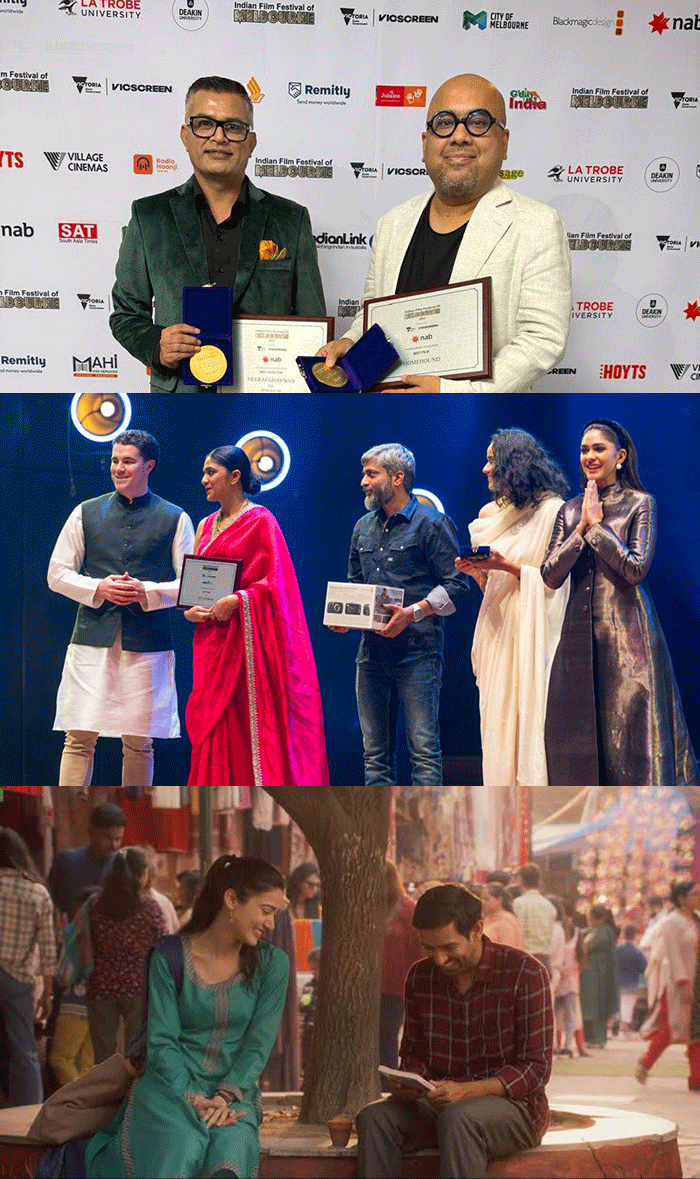
A look at the films that have won the Indian Film Festival of Melbourne's Best Film award — and what the pattern reveals ahead of IFFM 2026.
Some of the most interesting statements a film festival makes aren't in its opening speeches or its guest lists — they're in who wins. The Indian Film Festival of Melbourne (IFFM), the largest annual celebration of Indian cinema outside India, has been making a quiet but consistent statement through its Best Film awards. Look at the pattern across recent years and a picture emerges: a deep appreciation for intimate, human-scale storytelling — films that carry the weight of real India in every frame.
With IFFM 2026 arriving in August, it's worth looking back at the films that have defined the festival's taste — and asking what they tell us about where Indian cinema is headed.
The Films That Have Won — A Recent History
Here is a look at IFFM's Best Film winners across recent editions:
| Year | Best Film | Language |
|---|---|---|
| 2023 | Sita Ramam | Telugu |
| 2024 | 12th Fail | Hindi |
| 2025 | Homebound | Hindi |
Three very different films in tone, language, and setting — but with a shared sensibility. Each one is rooted in lived experience, built around characters who feel utterly real, and driven by emotion rather than spectacle. Together they form a portrait of what IFFM has chosen to celebrate
Sita Ramam (IFFM 2023 Best Film): A Love Story Across Time and Conflict
Directed by Hanu Raghavapudi and starring Dulquer Salmaan and Mrunal Thakur, Sita Ramam was a Telugu-language epic romance set against the backdrop of the 1964 Indo-Pakistani conflict. An orphaned soldier receives anonymous love letters — and everything follows from there.
What made the film remarkable wasn't just its sweep or its gorgeous production design — it was the emotional precision at its core. The film was widely praised for writing female characters with genuine agency and depth, and for finding a tenderness that didn't tip into sentimentality. At the IFFM 2023 awards at Hamer Hall, it took home Best Film. Rani Mukerji won Best Actress for Mrs Chatterjee vs Norway, and the Best Director award went to Kannada filmmaker Prithvi Konanur for Hadinelentu (Seventeeners) — a small independent Kannada film, which in itself says something about IFFM's range.
Sita Ramam's win was also a signal that IFFM's Best Film award isn't a Hindi-only conversation. The festival, which screens films across more than 20 languages, has consistently recognised the breadth of Indian cinema — from Telugu and Tamil to Kannada and Malayalam — not just the mainstream.
12th Fail (IFFM 2024 Best Film): The Sleeper That Woke Everyone Up
Vidhu Vinod Chopra's 12th Fail arrived in October 2023 without a thunderclap. It was a true story — based on Anurag Pathak's book about IPS officer Manoj Kumar Sharma, a boy from a village in Chambal who failed his Class 12 exams, fought through poverty and systemic failure, and cleared the UPSC to become a police officer.
Vikrant Massey's performance became the film's beating heart. One critic wrote it was "a paean to Vikrant Massey's astronomical amounts of sincerity." Made on a budget of 20 crore rupees, it earned over 69 crore rupees worldwide — a genuine sleeper hit. At India's 71st National Film Awards, Massey shared Best Actor with Shah Rukh Khan, and 12th Fail won Best Feature Film — an extraordinary double for a film of its scale.
At IFFM 2024, it won Best Film. The festival also honoured Kartik Aaryan with Best Actor for Chandu Champion, and Best Director was shared between Kabir Khan for Chandu Champion and Nithilan Swaminathan for the Tamil film Maharaja.
What critics noticed about 12th Fail — and what IFFM seemed to recognise — was its commitment to restraint. Long takes. Sound design doing the emotional heavy lifting. Characters rendered with such specificity that you forget they're performances. It was described as "the most pure, personal and brave Hindi film in a long time."
Homebound (IFFM 2025 Best Film): The Year Indian Cinema Went to Cannes
Neeraj Ghaywan's Homebound is his second feature — a full decade after his acclaimed debut Masaan, which won two awards at Cannes 2015 in the Un Certain Regard section. Homebound itself premiered at Cannes 2025, went on to become India's official Oscar entry for Best International Feature Film, and was produced by Dharma Productions with Martin Scorsese as executive producer.
The film follows two childhood friends — Shoaib (played by Ishaan Khatter), a Muslim, and Chandan (played by Vishal Jethwa), a Dalit — as they journey to take a police constable exam, chasing a uniform they hope will protect them from the discrimination they've faced all their lives. The story was drawn from a real New York Times photograph from India's COVID lockdown in 2020: two young men walking hundreds of kilometres, one cradling the other after he fainted in the heat.
Variety called it "a searing indictment of modern India" and "both a moving character piece and a drama in which aspirations collide with harsh political realities." The Hollywood Reporter called it simply "the best Hindi film of the year." At IFFM 2025, it won both Best Film and Best Director. Abhishek Bachchan won Best Actor for I Want to Talk, and Aamir Khan was honoured with the prestigious Excellence in Cinema Award as the edition's chief guest.
What the Pattern Tells Us
Look at these three winners together — a Telugu epic romance, a Hindi biographical drama, a Hindi social drama — and something becomes clear. IFFM isn't chasing a single definition of great Indian cinema. It's celebrating range. But within that range, there is a consistent pull toward films with real emotional stakes, films grounded in specific Indian lives and specific Indian truths.
Sita Ramam found its power in a love story told across partition and war. 12th Fail found it in a young man's refusal to stop trying. Homebound found it in two friends walking home. None of these films are small in ambition — quite the opposite. They're enormous in what they ask of their audiences emotionally. They simply don't need enormous budgets or enormous set pieces to get there.
This is what critics and audiences have started calling India's "quiet cinema" moment — not slow or inaccessible cinema, but films that earn their emotions through accumulation, through patience, through the ordinary made extraordinary. It's a tradition that has long thrived in Tamil, Malayalam, and Marathi cinema — and one that IFFM has been recognising across languages for years. What's notable now is that it's increasingly finding its way into mainstream Hindi cinema too, with films like 12th Fail and Homebound proving it can travel all the way to Cannes, to the Oscars, and to a packed house at the Palais Theatre in Melbourne.
IFFM 2026: What Comes Next?
IFFM 2026 arrives in August, with screenings both in-cinema across Melbourne and on the IFFM streaming platform for audiences across Australia. The question worth watching: which films carry the torch this year? Will the Best Film award continue in the direction of intimate, character-driven storytelling? And which new voices — in Hindi, Telugu, Tamil, Malayalam, Kannada, or any of the other languages that make Indian cinema what it is — will IFFM introduce to Melbourne audiences for the first time?
The festival has always been more than a screening programme. It's a conversation between Indian cinema and the world — and right now, that conversation is more alive than it has been in years.
The Indian Film Festival of Melbourne 2026 takes place in August. For screenings, tickets, and programme updates, visit iffm.com.au.