


The Indian Film Festival of Melbourne has steadily evolved into more than a cultural showcase for the diaspora. By 2025, IFFM had positioned itself as a significant waypoint on the global festival circuit, where films didn’t just screen, but entered international conversations around awards, auteurs, and cinematic relevance.
Several films associated with IFFM 2025 went on to feature prominently in Oscar shortlists, BAFTA nominations, and global festival lineups. What united them was not scale or spectacle, but specificity. These were stories deeply rooted in place, culture, and lived experience, yet accessible to audiences across borders.
Here are the standout films from the IFFM 2025 ecosystem that made global headlines.
Homebound
Directed by Neeraj Ghaywan
Few Indian filmmakers command international trust the way Neeraj Ghaywan does, and Homebound became one of the most talked-about Indian films of 2025. After its prominent presence at IFFM 2025, the film continued an extraordinary global journey.
Homebound premiered at the Cannes Film Festival in the Un Certain Regard section and later screened at the Toronto International Film Festival, consolidating its standing as one of the year’s most acclaimed South Asian films. It was subsequently shortlisted for Best International Feature Film at the 98th Academy Awards, placing it among the top fifteen films worldwide in that category.
While it did not make the final Oscar nominations, its shortlist presence marked a significant moment for contemporary Indian cinema, reaffirming that intimate, socially grounded storytelling continues to resonate globally.
Boong
Directed by Lakshmipriya Devi
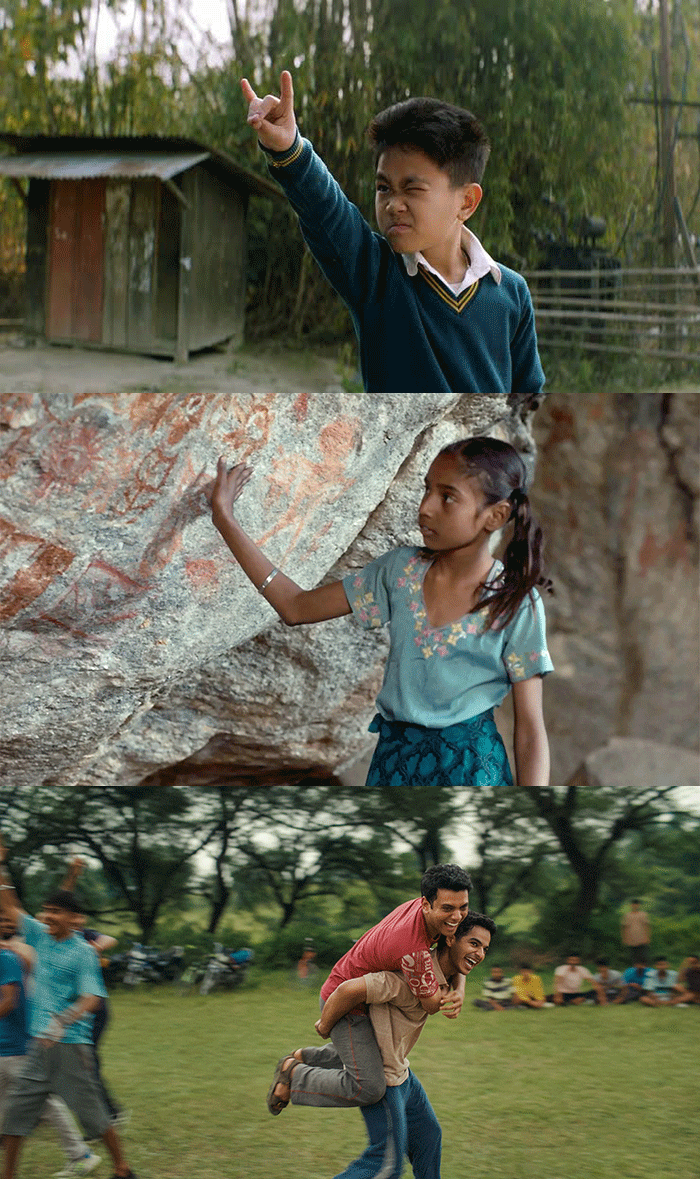
One of the most quietly impactful films to emerge from the South Asian festival circuit, Boong is a Manipuri-language coming-of-age film that found international recognition well beyond expectations.
In 2025, Boong earned a BAFTA nomination in the Best Children’s & Family Film category, a rare achievement for a regional Indian production.
The nomination brought global attention to cinema from Northeast India, a region still underrepresented in international film spaces. Boong’s success demonstrated that emotionally honest storytelling, when rooted in specificity, can cross linguistic and geographic boundaries with ease.
Humans in the Loop
Directed by Aranya Sahay
Humans in the Loop stood out at IFFM 2025 for its sharp engagement with contemporary realities. The film explores the invisible human labour behind artificial intelligence systems, foregrounding questions of class, caste, and digital ethics.
Following its festival run, the film entered the Academy Awards eligibility conversation, gaining attention for its relevance to global debates around technology and human cost.
While quieter in its awards visibility than some of its peers, Humans in the Loop became one of those films programmers and critics continued to discuss, highlighting IFFM’s role in spotlighting socially urgent cinema.
I, the Song
Directed by Dechen Roder
Bhutanese cinema continued its remarkable global ascent with I, the Song, which was officially selected as Bhutan’s submission for the Best International Feature Film category at the Academy Awards.
The film won multiple honours at the Bhutan National Film Awards and gained international visibility through festival screenings and critical coverage.
Though it did not secure an Oscar nomination, its submission reaffirmed the growing presence of smaller national cinemas in global awards conversations, a trend increasingly reflected in festivals like IFFM.
What IFFM 2025 Signalled About Global South Asian Cinema
Taken together, these films point to a larger shift. IFFM 2025 was not about chasing prestige titles but about curating voices that were already in dialogue with the world.
Indian and South Asian cinema today is increasingly defined by confidence in its own language, culture, and pace. These films do not explain themselves for international audiences. They trust them. And that trust is being rewarded with recognition, conversation, and critical engagement.
IFFM’s role in this ecosystem is now clear. It is no longer just a celebratory platform, but a connector, a space where local stories meet global futures.