


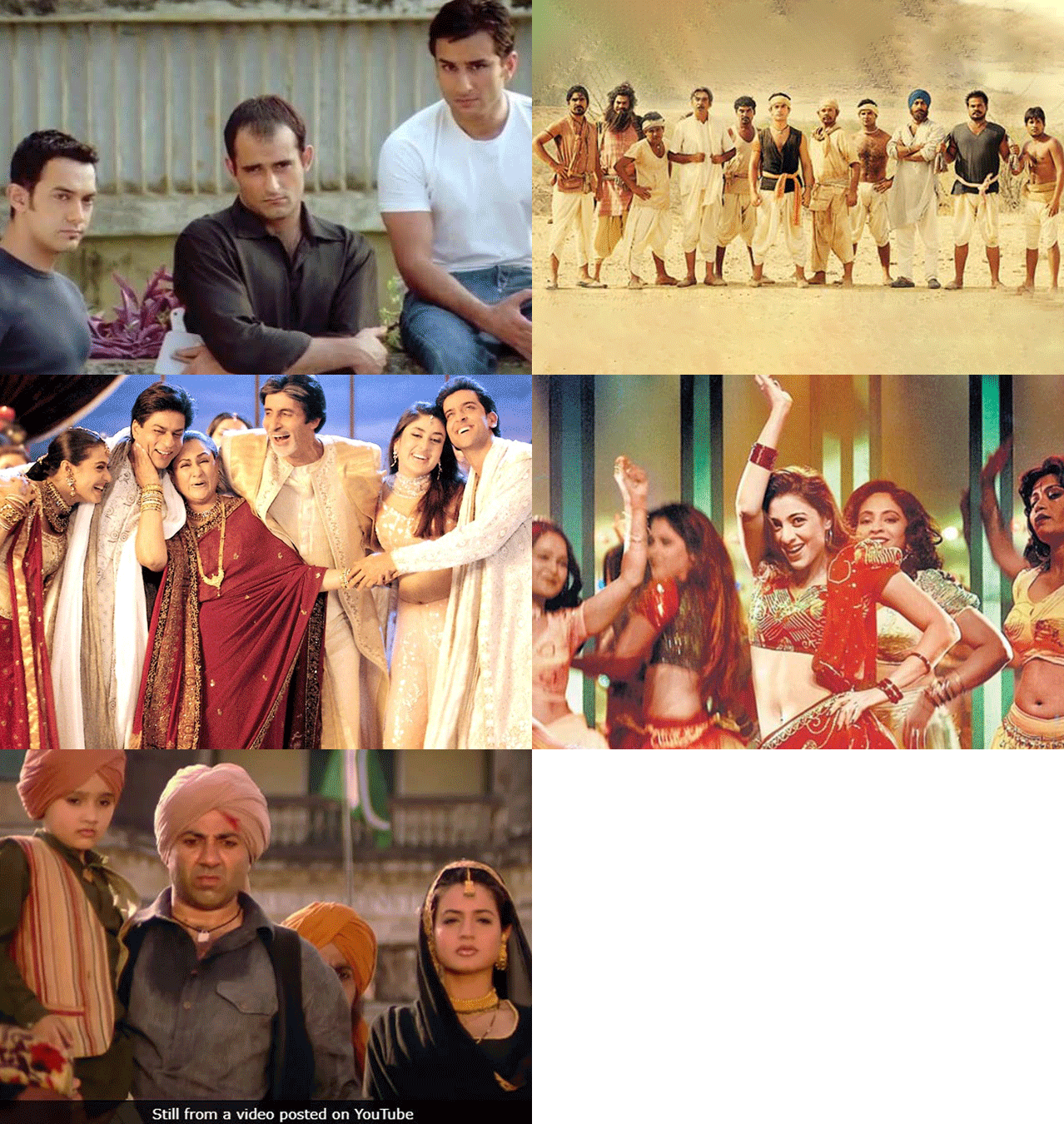
Some years age well. Others stay frozen in time. And then there are years like 2001 that keep unfolding, revealing new meaning every time you look back.
It wasn’t just a strong year for Hindi cinema. It was a turning point. Five films — wildly different in tone, scale, and intent — arrived almost together and quietly rewrote the rules. Lagaan, Dil Chahta Hai, Chandni Bar, Kabhi Khushi Kabhie Gham, and Gadar: Ek Prem Katha didn’t belong to the same cinematic world. And that’s exactly why they changed everything.
For the first time, Indian cinema stopped behaving like a single industry.
The Improbable Epic
When Lagaan released, it didn’t just feel ambitious — it felt improbable. A period film set in colonial India, rooted in rural texture, driven by cricket, stretching close to four hours. And yet it travelled in a way mainstream Hindi cinema hadn’t managed in years.
The Oscar nomination for Best Foreign Language Film was significant not just as recognition, but as a shift in perception. Indian cinema was no longer just song-and-dance spectacle for international audiences. It could be epic, emotionally layered, and deeply rooted in a specific place and time — and still land universally.
For Aamir Khan, who also produced the film, it marked a decisive turn toward risk-driven, content-first cinema. Ashutosh Gowariker went from struggling filmmaker to director with genuine global credibility. Even the supporting cast — including British performers Paul Blackthorne and Rachel Shelley — contributed a cross-cultural texture that felt genuinely new.
Lagaan didn’t just expand the scale of what Hindi cinema could attempt. It expanded what the industry believed it was allowed to attempt.
A New Register
If Lagaan looked outward, Dil Chahta Hai turned inward — and in doing so, changed how Hindi cinema spoke.
Farhan Akhtar’s debut didn’t rely on melodrama or manufactured conflict. It leaned into ease. Conversations moved like real ones. Friendships were unspoken, messy, sometimes unresolved. It caught a version of urban India that had existed for years but rarely appeared on screen with this kind of honesty.
The cast found new versions of themselves in it. Aamir Khan shed intensity for something lighter and more contemporary. Saif Ali Khan found a comic timing that would redefine his career entirely. Akshaye Khannadelivered a performance so internal it barely registered as acting — which was, of course, the point. Preity Zinta and Dimple Kapadia added emotional weight without tipping into cliché.
Dil Chahta Hai influenced more than films. It influenced behaviour, fashion, friendships, the rhythm of dialogue. It was the moment a more self-aware, globally exposed generation of Indians saw themselves, clearly, for the first time.
What Comfort Won’t Show You
Chandni Bar arrived in the same year and cut through it all with something different: discomfort.
Madhur Bhandarkar’s film walked into Mumbai’s bar dance world and refused to look away — from the exploitation, the survival, the cycles of violence that the city’s glamour conveniently obscures. It wasn’t easy viewing. It wasn’t meant to be.
Tabu’s performance became the film’s entire gravitational centre. Atul Kulkarni brought a quiet, unsettling complexity. Together, they built a world that felt lived-in rather than constructed, specific rather than representative.
For Bhandarkar, the film defined his voice. For the industry, it reopened something that had been quietly closing — the space for stories that don’t comfort, that don’t resolve neatly, that leave you sitting with something unpleasant long after the credits end.
Home, At Scale
Kabhi Khushi Kabhie Gham knew exactly what it was, and committed to it completely.
Karan Johar assembled Amitabh Bachchan, Jaya Bachchan, Shah Rukh Khan, Kajol, Hrithik Roshan, and Kareena Kapoor, placed them inside a world of heightened emotion and visual grandeur, and aimed squarely at audiences who had left India but carried it with them. The film became one of the highest-grossing Indian releases internationally at the time — not despite its excess, but because of it.
For Hrithik Roshan and Kareena Kapoor, both still finding their footing, K3G settled something. For Shah Rukh Khan, it deepened an identity he’d been building for years. For Johar, it established a register of cinema — emotional, aspirational, unapologetically large — that few have been able to replicate since.
What the film understood, better than almost anything before it, is that for a diaspora audience, spectacle isn’t indulgence. It’s belonging.
The Other India
And then there was Gadar.
Where the other four films were, in different ways, pushing at what Hindi cinema could become, Gadar: Ek Prem Katha planted its feet. Set during Partition, it leaned into high drama, nationalism, and unadorned romance without apology. Sunny Deol’s Tara Singh became iconic for reasons that are hard to explain clinically — sheer physical presence, emotional rawness, a complete absence of self-consciousness. Ameesha Patel held her ground opposite him. Amrish Puri, as the conflicted antagonist, brought the weight that only he could.
The film was enormous in single-screen theatres, with audiences in numbers that made the rest of the industry pay attention. It proved something the urban, multiplex-focused narrative of progress tends to overlook: the mass audience was not a relic. It was still the majority.
Gadar wasn’t a counterpoint to the year’s ambitions. It was part of them.
One Year, No Single Answer
What made 2001 extraordinary wasn’t that these films succeeded. It was that they succeeded simultaneously, each on entirely different terms.
A rural epic earned an Oscar nomination. An urban friendship story became a generational touchstone. A gritty social drama found audiences who weren’t looking for easy exits. A glossy family saga sold homesickness back to a diaspora and made it feel like joy. And a high-decibel love story set against Partition broke box office records in theatres where the floor sometimes shook.
There was no longer a single definition of what a Hindi film should be, or who it should be for.
Still Here
The year’s influence didn’t fade. It compounded.
The ease of modern urban cinema traces back to Dil Chahta Hai. The global ambitions of Indian films today are inseparable from what Lagaan proved possible. The raw, location-driven storytelling that emerged through the following decade has Chandni Bar somewhere in its DNA. Every large-scale family spectacle built for overseas audiences is, in some way, in conversation with K3G. And the appetite for mass, emotionally direct cinema — the kind that fills single screens and doesn’t apologise for its volume — never went anywhere, because Gadar reminded everyone it was still there.
More than outcomes or box office numbers, 2001 gave the industry something harder to quantify: permission to contradict itself. To be many things at once. To stop searching for the definitive Hindi film and start making a dozen different ones.
Twenty-five years later, we’re still working inside the space it opened.